The Moldy Bread Problem: Gibeon, Deepfakes, and the Danger of Verifying Only What You Can See
The Biblical Record
Gibeon (Hebrew: גִּבְעוֹן, Giv'on, meaning "hill") comes into the story in Joshua 9, right after Israel's victory at Ai. Word of Jericho and Ai had spread. The kings of the land were gathering to fight Israel. Gibeon took a different approach: it didn't fight. It deceived.
The Deception (Joshua 9:3–15)
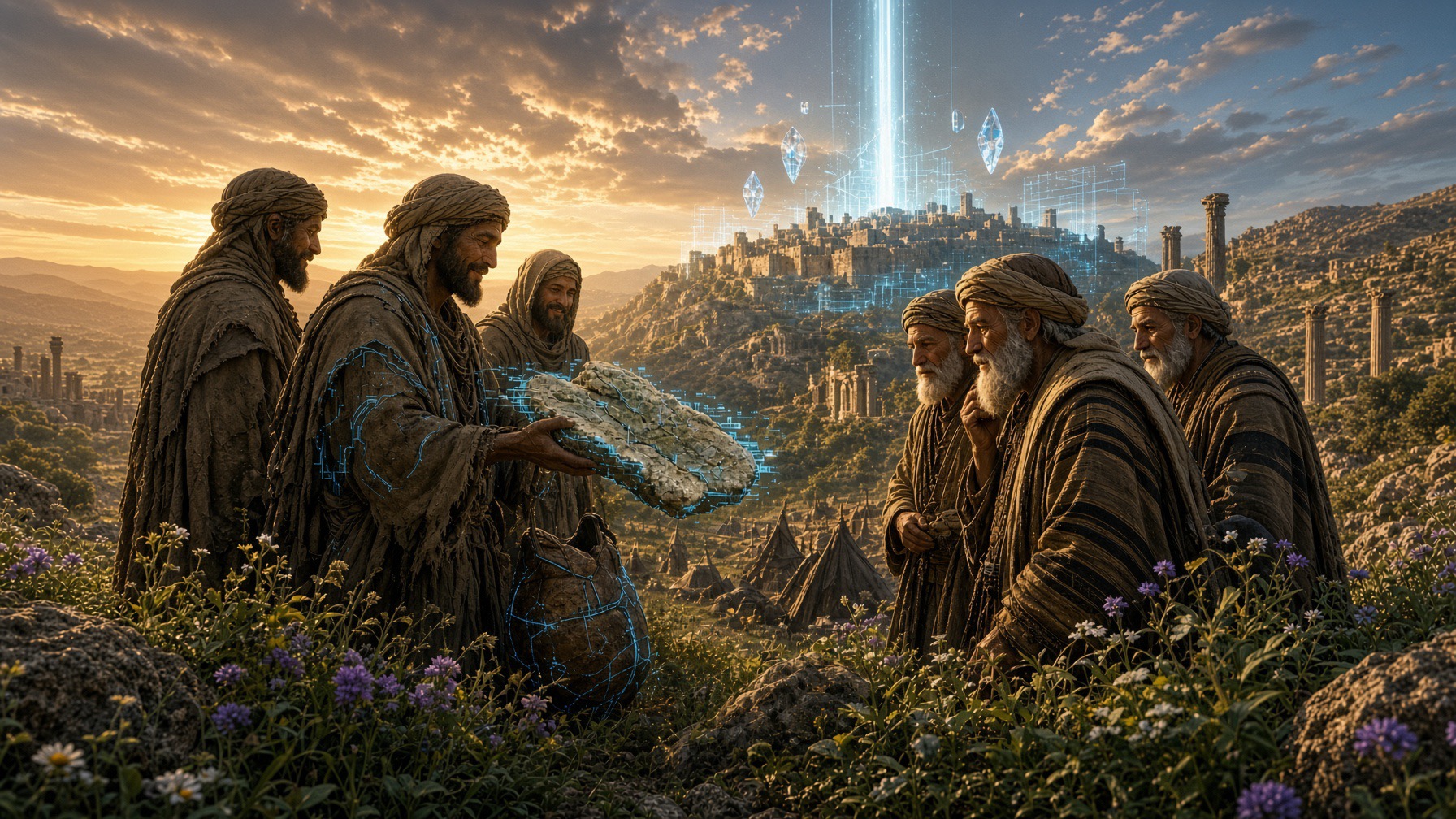
The Gibeonites were Israel's near neighbors, but they put together a costume. They wore patched sandals and old clothes. They carried torn wineskins that had been sewn back together and bread that was dry and moldy. They walked into Israel's camp and said, "We have come from a far country. Make a covenant with us."
Israel was suspicious at first: "Perhaps you live among us." So the Gibeonites gave more detail. They had heard about everything God did in Egypt and to the two Amorite kings east of the Jordan.
Notice what they left out. They never mentioned Jericho or Ai. Travelers from far away wouldn't have heard such recent news yet. The cover story was consistent all the way through.
Israel's leaders examined the evidence. The key verse is 9:14: "The men took some of their provisions, but did not ask counsel from the Lord."
They made a covenant and swore an oath.
The Discovery (Joshua 9:16–27)
Three days later, Israel learned the truth: Gibeon was only a short march away. The people complained against their leaders. The leaders answered, "We have sworn to them by the Lord. We cannot touch them."
The oath couldn't be undone. So Joshua limited the damage. The Gibeonites were spared, but they became woodcutters and water carriers for the house of God, serving the people they had fooled.
The Correlations to Modern AI
Truth AI lens on:
1. Moldy Bread and Worn Sandals = Deepfakes and Synthetic Evidence
The Gibeonites didn't just tell a lie. They built physical proof to back it up. Every prop was chosen to pass inspection.
This is how deepfakes and synthetic media work. A fake voice call from a "CEO," a made-up invoice, or an AI-generated document doesn't ask you to trust it. It gives you evidence that looks real. The more convincing the evidence, the less anyone thinks to question it.
2. "They Took of Their Provisions" = Checking the Output Instead of the Source
Israel did perform a check. They tasted the bread, and it really was stale. The data was real. The story behind it was false.
This is the central weakness in AI verification today. Systems check the content: Does it look right? Is it consistent? Is the formatting correct? They don't check where it came from. The growing push for content provenance, which means tracking where a piece of media originated, is the field learning what Joshua 9:14 already taught. You can confirm every detail and still be deceived if you never go to the authoritative source.
3. The Missing Mention of Jericho = Adversaries Who Model Your Expectations
The Gibeonites' best move was what they didn't say. They knew what a real traveler from far away would and wouldn't know, and they matched it exactly.
Modern adversarial attacks work the same way. Social engineering, prompt injection, and fraud built with AI succeed because the attacker has studied what the target expects. A consistent story isn't proof that it's true. Sometimes it just means someone prepared carefully.
4. The Unbreakable Oath = Irreversible Deployment
Once the oath was sworn, it couldn't be taken back, even though it was based on fraud.
Some AI decisions work the same way. A model gets built into critical systems, contracts get signed, and data gets shared. Discovering later that the foundation was flawed doesn't give you a way out. The lesson is to verify before you commit, because a commitment can outlive the truth that should have stopped it.
5. Woodcutters and Water Carriers = Containment
Joshua couldn't reverse the covenant, but he could decide what role the Gibeonites would play. They stayed, but in a limited, supervised position.
In AI safety, this is called containment and sandboxing. If you can't remove a system, you restrict what it can reach, what it can do, and who it answers to.
6. The Ambushers Get Ambushed
At Ai, Israel won through a planned deception. One chapter later, Israel lost through someone else's deception. The same tactic that brings victory can be used against you.
This is why red teaming never ends. Every technique a security team uses to test its systems is also available to someone who wants to break them.
The Summary Table
At Ai, Israel lost because of corruption hidden inside the camp. At Gibeon, Israel was fooled by a deception brought in from outside. Both failures had the same root: something wasn't checked at the source.
What Israel lacked wasn't better inspection. They lacked the one question they didn't ask. In an age of synthetic evidence, "Does this look real?" is no longer enough. The question has to be: "Where did this actually come from?"
And the story doesn't end in failure. In Joshua 10, when five kings attacked Gibeon, Israel honored its oath and marched to defend the city, and God fought for Israel that day. The covenant that started with a mistake became the setting for one of Israel's greatest victories.
"Scripture study and AI correlations explored with the help of AI."
Comments
No comments yet. Yours can be the first.
Leave a comment